Cross compilation the Application for RZ/V2H RDK
This section provides the overview of cross-building applications for the Renesas RZ/V2H RDK platform.
What is Cross-building?
Cross-building is the process of compiling software on a host system to run on a different target system.
The advantages of cross-building is that it allows developers to build applications for embedded systems without needing to compile directly on the target device, which have limited resources causing longer build times.
In this case, we will be cross-building applications on a development machine (Ubuntu PC 24.04 host) to run on the Renesas RZ/V2H RDK (target).
Note
The primary focus of this section is cross-building ROS 2 applications.
However, the cross-build environment can also be used to build non-ROS applications, provided they are compatible with the RZ/V2H RDK Linux image and the supplied toolchain.
How ROS 2 Cross-building Works
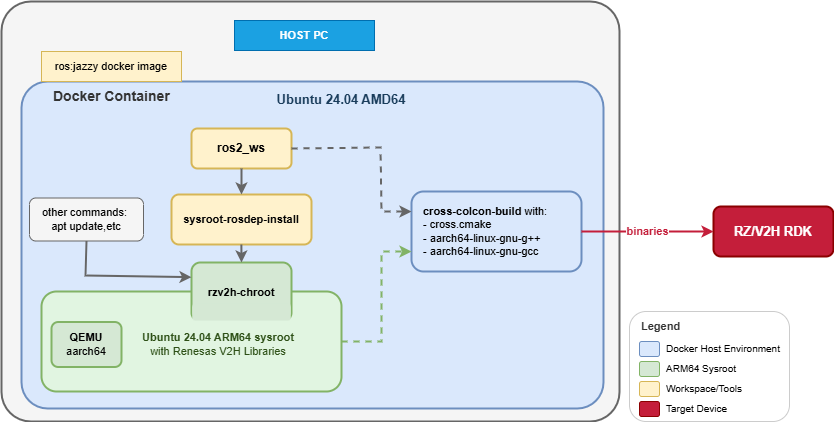
Cross-build system overview
The cross-build environment runs inside a Docker container on the host machine. This container is pre-configured with the necessary toolchains and a sysroot - a copy of the target device’s root filesystem that provides the libraries and headers needed during compilation.
To handle architecture differences, the system uses QEMU to emulate the ARM64 architecture. This allows the Docker container running on an x86_64 host to execute ARM binaries, which is essential for tasks such as installing dependencies and running configuration scripts that need to behave as if they are on the target device.
The container also leverages the chroot technique to create an isolated filesystem environment that mimics the target RZ/V2H system. When entering this chroot environment, QEMU transparently intercepts ARM64 binary execution, enabling tools like apt-get and rosdep to resolve and install packages as though they are running natively on the target hardware.
The overall workflow is:
The RZ/V2H RDK Linux Image provides the root filesystem, which is used as the sysroot inside the Docker container.
Dependencies are resolved and installed into the sysroot through the QEMU-emulated chroot environment.
The cross-compilation toolchain compiles the application source code on the host, linking against the libraries in the sysroot to produce ARM64 binaries.
The resulting binaries are ready to be deployed to the RZ/V2H RDK target device.
Tip
You can think of the ARM64 sysroot with QEMU emulation as a “virtual RZ/V2H RDK environment” inside the Docker container, which allows you to install dependencies or execute any command via arm64-chroot as if you were directly working on the RZ/V2H RDK.
Limitations
Command execution inside the chroot environment may be slower due to QEMU emulation. Please be patient when running commands.
Only one chroot instance can run simultaneously within the Docker container.